
One of the most uncivilised characteristics of this war has been the total disregard for international law and the laws of armed conflict, asserts Vice Admiral Biswajit Dasgupta (retd).

Double Olympic champion Caster Semenya says she intends to fight against the introduction of gender testing for the female category at the Olympics, a policy the South African insists "undermines women's rights".

'Samrat Chaudhury's limited independent standing within the party, his reliance on the central leadership for his elevation, and his lack of a personal mass base all point toward this outcome.'

Congress leader Rahul Gandhi has accused Kerala Chief Minister Pinarayi Vijayan of aligning with forces that attack minorities, during election rallies in Kerala. He also criticised the CM on other issues including alleged corruption and economic failures.

NCP (SP) leader Anish Gawande has urged the government to withdraw the Transgender Persons Amendment Bill, 2026, arguing that it undermines the right to self-determination of gender identity and was drafted without adequate consultation.
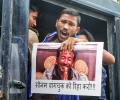
The Supreme Court has sought responses from the Centre and the Ladakh administration regarding the detention of climate activist Sonam Wangchuk under the National Security Act (NSA). Wangchuk's wife has filed a plea challenging the detention, claiming it violates his fundamental rights. The court has given the Centre and Ladakh administration 10 days to respond and has scheduled the next hearing for November 24.

The Bombay High Court granted bail to Akashdeep Karaj Singh, an accused in the murder of NCP leader Baba Siddique, citing insufficient evidence to link him to the organized crime syndicate allegedly involved.

Thousands of Naga students and citizens rallied in Kohima, Nagaland, opposing the central government's directive to mandate the singing of Vande Mataram in official functions and educational institutions, citing concerns over secularism and religious freedom.

A referendum on the implementation of a reform package in Bangladesh saw a 60.26 per cent voter turnout, with the 'yes' vote winning a clear majority, the Election Commission announced.

The NHRC has issued a show cause notice to the Tamil Nadu government regarding an attack on a migrant worker, identified as Suraj, demanding his tracing, medical treatment, and compensation.

The Supreme Court has directed the Election Commission to display the names of those on the 'logical discrepancies' list at various public offices in West Bengal, addressing concerns about irregularities in the voter rolls.
Justice Swarana Kanta Sharma said a convict does not become a lesser citizen only due to his incarceration and, in the present case, where the "biological clock" of the convict and his partner may become a barrier for them to conceive once the sentence got over, the fundamental right to have a child "cannot be deemed to be surrendered in favour of the State".

With growing opportunities in the coaching, sports science, training and wellness industries, a career in sports provides a dynamic and fulfilling career path.

The BJP and the Opposition have engaged in a war of words over the implementation of the women's reservation bill, which aims to reserve seats for women in legislatures. The bill was defeated in the Lower House, leading to accusations and counter-accusations between the parties.
The policy unveiled by the home ministry is based on seven key pillars to counter the terror threats emanating from India or abroad -- prevention, responses, aggregating internal capacities, human rights and "Rule of Law"-based processes.

Lok Sabha takes up FCRA Amendment Bill amid opposition protests.

The Supreme Court of India dismissed a plea seeking the inclusion of Vinayak Damodar Savarkar's name in the Emblems and Names (Prevention of Improper Use) Act, 1950. The petitioner, appearing in person, argued for the inclusion based on his 30 years of research and claimed a need to establish facts about Savarkar in a legally verifiable manner. However, the court found no violation of fundamental rights and suggested the petitioner make a representation to the Union of India for curriculum inclusion. This dismissal follows the court's earlier reprimand of Congress leader Rahul Gandhi for his remarks on Savarkar at a rally in Maharashtra, although criminal proceedings against Gandhi were stayed.

'The directives to enhance last-mile funding, consider revival funds, and systemic reforms across the sector are expected to revive stalled projects, improve accountability, and accelerate the delivery of affordable and mid-income housing.'
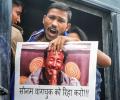
The Centre and the Union Territory of Ladakh administration have accused jailed climate activist Sonam Wangchuk of attempting to instigate Gen Z for protests, drawing parallels to unrest in Nepal, Bangladesh, and the Arab Spring.

Economist Jeffrey Sachs saw Gulf nations' decision to partner with the US through the Abraham Accords as an "invitation for disaster" as it made them more dependent on American protection.

The Supreme Court of India has ruled that maternity leave is a fundamental right and cannot be denied to a woman based on the number of children she has from previous relationships. The court overturned a Madras High Court decision that had denied maternity leave to a Tamil Nadu government school teacher who had two children from a previous marriage. The Supreme Court emphasized the importance of reproductive rights, including maternity benefits, as part of international human rights law. The court also highlighted the right to life under Article 21 of the Indian Constitution, which includes the right to health, dignity, and reproductive choice. The decision has significant implications for women's rights and reproductive healthcare in India.

The CBI took over the case from an SIT following a Supreme Court order, and the investigating agency has been gathering evidence relating to the stampede that occurred during a political meeting addressed by Vijay on September 27, 2025 in Karur, Tamil Nadu. The incident had left 41 dead and more than 60 injured.

Top female executives are calling for corporate India to redesign workplace systems to support women's advancement into leadership roles in the technology sector, particularly in emerging fields like artificial intelligence.

The Supreme Court on Monday said citizens must know the value of the right of freedom of speech and expression, and exercise self restraint as it mulled guidelines to regulate offensive social media posts.

TVK chief Vijay was questioned by the CBI for six hours in connection with the Karur stampede case. The investigation is ongoing, with the CBI gathering evidence and analyzing statements to determine responsibility.

The ceasefire is still technically holding, to the extent that no overt hostilities have been reported yet, but the rhetoric has hardened dangerously. The week ahead will also clarify whether the Islamabad failure was a negotiating tactic or whether Washington has genuinely locked itself into a position from which the only exits are climb-down, escalation, or the slow bleed of a new status quo that nobody chose and nobody controls. Prem Panicker continues his must read blog on the Iran War.

By all available indications, the White House drafted a face-saving note and handed it, ready-made, to Islamabad. Pakistani Prime Minister Shehbaz Sharif was supposed to then post it in the guise of a plea urging Trump to extend the deadline by two weeks 'to allow diplomacy to run its course'. Trump would then graciously accept Pakistan's 'request' and declare a ceasefire. Sharif dutifully posted the message on X. Except that he, or whoever was handling the account, forgot to delete the tell-tale first line visible in the edit history: 'Draft - Pakistan's PM Message on X'. Prem Panicker's must read blog on the Iran War.
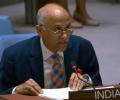
Asserting that democracy is an 'alien' concept for Pakistan, India has called upon Islamabad to end grave human rights violations in territories under its illegal occupation, where the population is in 'open revolt' against military occupation, repression, brutality and exploitation.

"It is quite possible that the rates will remain low in the near to medium term, but that will depend on how conditions evolve," said RBI Governor Sanjay Malhotra.

Benchmark indices tumbled about 2 per cent on Friday, capping one of the most turbulent weeks for domestic equities as investors fretted that the West Asian conflict could drag on for weeks or even months.

'The Supreme Court stated that once the delimitation plan is approved by Parliament and receives assent of the President, it cannot be undone. Nor can it be modified.'

Manipur Chief Minister Y Khemchand Singh expressed optimism following a meeting with the Kuki Zo Council, viewing it as a positive step towards restoring peace and trust between the Meitei and Kuki communities in the state.

'We were in a heavily nuclearised environment. China had tested for Pakistan in the 1980s and helped their missile programme stay just one step behind us.'

'The West Asia or the Gulf crisis has shown that what we develop as national infrastructure when things are not as bad as they could be, we forget to plan for adversities.'

'The unregulated marketing has to stop. People are getting recommendations for this from gym trainers, from marriage counsellors -- that is simply unacceptable.' ''There are many ways to lose weight -- eat less, fast, exercise, eat healthy. That is how you lose weight.'
A family dispute between a Pakistani Hindu husband and wife, living in different countries after their marriage in 2020, has reached the Madhya Pradesh High Court after reconciliation attempts failed. The wife accuses the husband of planning a second marriage and seeks his deportation.

Kuki organizations are demanding justice after a Kuki woman from Manipur died from an illness allegedly linked to the trauma she suffered after being gang-raped in 2023. They allege government inaction and demand an independent probe.

'The story of Ghooskhor Pandat focuses on an individual's actions and choices and does not comment on or represent any caste, religion, or community. As a filmmaker, I approach my work with a deep sense of responsibility -- to tell stories that are thoughtful and respectful.'
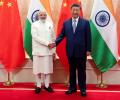
Chinese President Xi Jinping described India and China as "good neighbours, friends and partners", saying that achieving "dragon and elephant dancing together" is the right choice for both countries.

US President Donald Trump announced a new global levy on imported items, resulting in a lower tariff rate for India, following a Supreme Court verdict against his previous sweeping tariffs.
